
Case study · 18 October 2026
A website from one page of brief
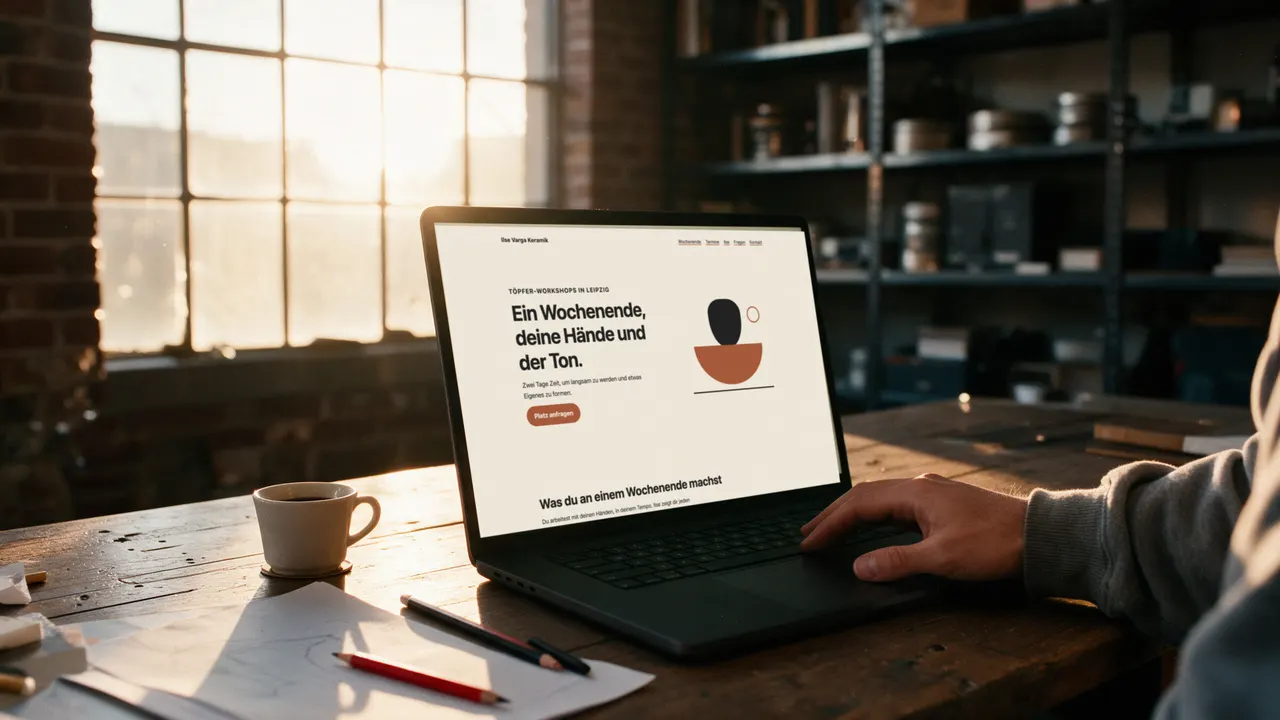
A one-page brief for a fictional pottery workshop in Leipzig goes in. The studio builds the site and the hand-over on its own, in a sealed test with nobody to ask.
The use case at a glance
- The brief
- Weekend pottery workshops in Leipzig, booked by email request, in German with "du". Everything is decided up front: one page, the sections, three brand colours, system fonts, simple shapes instead of photos, no tracking and no cookies. The imprint and privacy pages stay placeholders for a lawyer's check, and the domain and hosting are the owner's steps.
- The approach
- The test runs in a sealed folder: a fresh session, the brief and nothing else. The studio has to deliver the site, a test report, a ready-to-publish note and the go-live steps.
- Tools
- Claude Code, RSAI Creative Studio 0.5.0, claude plugin eval (Claude Code's plugin test runner), HTML, CSS and JavaScript
- The result
- In the full test on 18 October 2026 the studio scored 1.00 on both runs: home page, imprint and privacy pages, the hand-over note and the go-live steps, each run in 6 to 9 minutes. The same test without the studio scored 0.60: the page passed, the go-live steps and the hand-over note didn't. Nothing went live. The domain, hosting and publishing stay the owner's steps.
The approach
The test runs in a sealed folder: a fresh session, the brief and nothing else. The studio has to deliver the site, a test report, a ready-to-publish note and the go-live steps.
It builds a static site in German: the home page, the imprint and privacy pages, the styles and a gentle fade-in that switches off for people who turn motion down. Then it writes the hand-over: what is finished, how to open it locally and the owner's remaining steps in order, with clear placeholders where only the owner has the values.
Five checks score every run. One confirms the page exists and one finds the button "Platz anfragen". An AI judge reads the page against the brief in three votes and fails it for invented prices, dates or testimonials. A second judge reads the hand-over, and a pattern check reads the go-live steps.
Getting there took fixes. On 17 and 18 October the test scored 0.60 several times: the page passed, but the go-live steps came out in the wrong format and the hand-over note failed. The go-live format went into the studio's website skill, and the studio now loads that skill before it builds. After that the score held at 1.00.
1.00score with the studio, 2 of 2 runs, 18 Oct 2026
0.60the same test without the studio, 2 runs
5checks on every run
6–9 minper run with the studio, no human help
The work
The result
In the full test on 18 October 2026 the studio scored 1.00 on both runs: home page, imprint and privacy pages, the hand-over note and the go-live steps, each run in 6 to 9 minutes. The same test without the studio scored 0.60: the page passed, the go-live steps and the hand-over note didn't. Nothing went live. The domain, hosting and publishing stay the owner's steps.
What the studio learned
The test shows the studio can take a short, fully decided brief and deliver a complete static site plus a hand-over the owner can act on, the same way on every run. Claude Code without the studio misses the hand-over. The test shows less than a real job would. The brand is fictional, and the scores come from pattern checks and AI judges, not from a client. The sealed test has no browser, and one run's own report left its real-browser checks open.