Brief the studio

AI Story · NRW · Germany · since 13 June 2026

Creative AI Mastermind

The intelligence layer for the Creative AI economy: a platform and a peer collective where creative people who work with AI see what exists, show what they can do, and find the people who complete their work. Initiated by Javier Amaya with Rapid Stories AI.

The use case at a glance

The brief
Creative people across NRW learn AI fast, then go back to their desks and build alone. What they lack is visibility. There is no way to say precisely what you can do, and no way to find the person whose work completes yours.
The approach
Map what people can really do, prove it through real projects, and turn it into a graph that connects people, projects, learning and funding.
Tools
Next.js, React, three.js, Supabase in Frankfurt, Vercel, Claude, Google Model Armor
The result
A live platform with AI Radar, AI Graph, AI Funding and AI Projects, a peer collective in Düsseldorf, and the Creative AI day of AI Week Düsseldorf on 27 November 2026.

Why it exists

Javier teaches AI workflows across NRW. People left his sessions able to do the work, then went back to their desks and did it alone. In his words: “After about the twentieth session it stopped looking like a coincidence and started looking like the actual problem.”

The region has events, tools and news. What it lacks is structure for the part that matters: finding the right people to build with. CAIM is the intelligence layer for the Creative AI economy. Its goal is to make the Creative AI industries visible, connected and able to grow.

What it is

A platform and a peer collective for designers, filmmakers, strategists, builders, producers and operators who work with AI, across the creative economy of NRW and Germany: film and TV, games, music, design, advertising, communications, architecture, publishing, the arts and creative tech. It answers two questions. What exists? And what can you do, and who completes your skills?

The home page of Creative AI Mastermind: The intelligence layer for the Creative AI economy, with the STARTPLATZ cooperation partner badge

How people use it

AI Radar: what exists

Events, education, tutorials, funding and jobs in one place. Every card links to its source and passes automatic checks before it goes live. On 27 October 2026 it lists 20 events in NRW and 61 education programmes, and it changes every week.

The AI Radar on its Education tab: Creative AI Education in NRW, with a masterclass card and filters by city and month

AI Graph: what you can do

You pick your languages, education, professions, skills, tools and AI models from one shared list: 15 professions, 244 skills, 120 tools and 52 AI models, all on one five-step scale from Learning to Teach it. Nothing is typed into a free field, so profiles stay comparable.

The AI Graph page: Creative AI Graph, Matchmaking your knowledge and competencies, with the 15 profession tiles open

Your skills as a galaxy

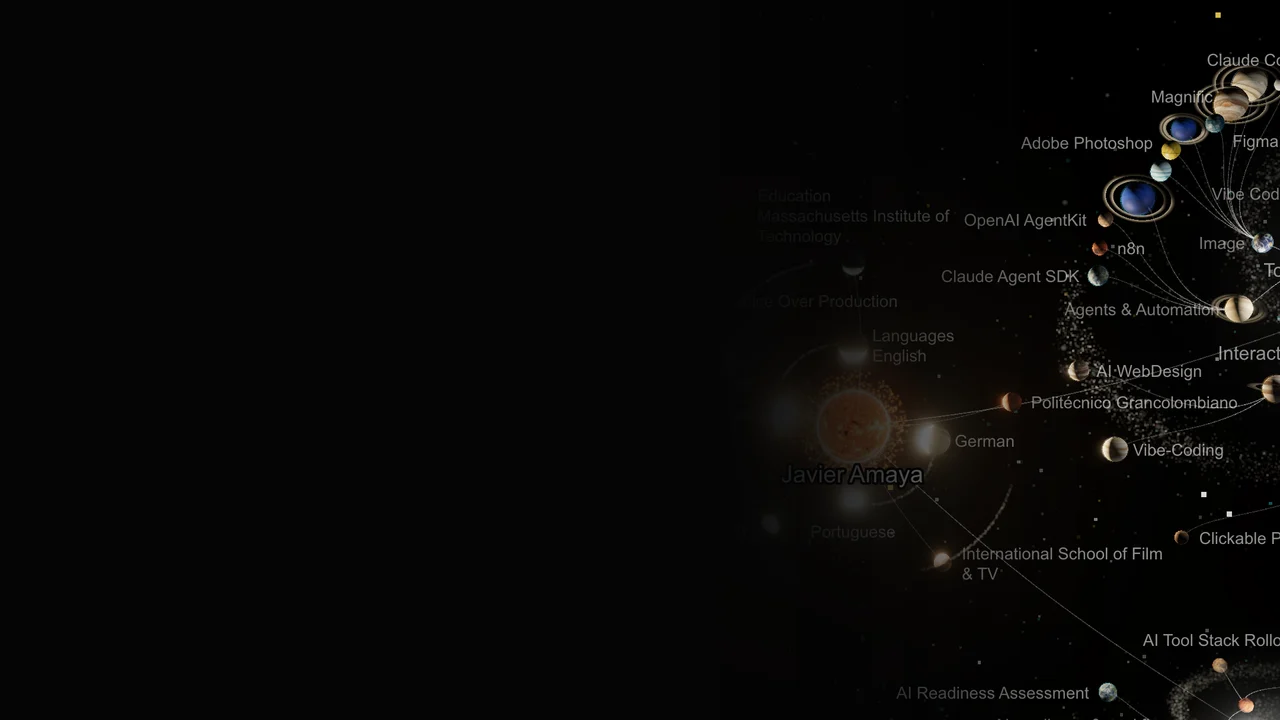
The same data draws itself as a map: the person at the centre, with Creativity, Technology and Strategy as three galaxies around them. It renders in 2D or 3D and downloads as a picture. This one is Javier’s own graph.

The AI Graph in 3D: Javier Amaya as a glowing sun at the centre, with planet clusters for Creativity, Technology and Strategy and labels for skills and tools

AI Funding: where the money is

75 funding programmes for creative work with AI in NRW, Germany and the EU, with the fields that decide whether one fits. The table says openly that AI helped extract it: “AI-assisted extraction · Art. 50 AI Act”.

The AI Funding page, signed in: the title Creative AI Funding, the AI Act Art. 50 label, and the table with programme, institution, concept, purpose and funding type for each programme

AI Projects: proof through work

13 open project proposals in 6 categories. Members join one or bring their own. A profile says what someone believes they can do; a finished project shows it.

The AI Projects page: Creative AI Projects, Build what others just talk about, with the featured project Recovered Cities

The collective: people first

Two online sessions and one working session in Düsseldorf every month: Show & Tell, Project Review, Working Session. The collective decides what gets done.

The AI Collective page, headed “Real work. Real projects. Human connection.”, with the three monthly stages

75funding programmes in AI Funding

244skills in the AI Graph, across 15 professions

13open project proposals

14blog posts, built in the open since June

How the tech works

One flow keeps the platform current without anyone typing it in by hand, and with people deciding wherever it matters.

  1. SourcesEvents, courses, funding and jobs across NRW, Germany and the EU
  2. Weekly sweepClaude researches new cards
  3. ChecksDead links, past dates, missing languages and duplicates are dropped; Google Model Armor screens the rest
  4. DatabaseSupabase in Frankfurt
  5. PlatformRadar, Graph, Funding and Projects, in English and German
  6. PeopleMembers, and the Monday digest by email
The website
Next.js 15 and React 19 on Vercel, with its functions in Frankfurt. English and German are written separately, never machine-translated.
The database
Supabase in Frankfurt, with row-level security on member data. Sign-in with Google, LinkedIn or email.
The AI
Claude Haiku 4.5 reads documents and turns them into skills. Claude Sonnet 5 runs the graph conversation for a preview group.
The checks
A weekly sweep adds new cards and retires old ones; it never edits a live card. Doubtful cards wait for Javier, and any card can be withdrawn with one click.
The galaxy
three.js with React Three Fiber; the planets carry real NASA surface maps.

Trust by design

Members enter and confirm their own profile. Nothing is scraped, and no skill is attributed to anyone without them seeing it. They can export, correct or delete their data at any time, and the data is not sold. The database lives in Frankfurt. Text written with AI says so, and analytics run only after consent.

One director, a team of AI models

Javier does not write code. He directs: Claude plans, Codex engineers the layouts, database changes and tests, and Gemini reviews what actually appears on the screen. Work from one model family is checked by another. “The models never vote; the code, the tests and the rendered page decide.” The whole build happens in the open, on the CAIM blog.

The strategy

Map what people can really do, prove it through real projects, then turn it into a graph that matches people with partners, projects, learning and funding. The skills follow ESCO, the EU’s own classification, so a profile means the same thing in Düsseldorf and in Lisbon. NRW is the pilot, Germany is next, Europe is the destination.

CAIM carries the idea behind Rapid Stories AI to a whole community: AI as the enabler, people at the centre, and work that proves itself.

AI Week Düsseldorf

On Friday 27 November 2026, CAIM co-designs the Creative AI day of AI Week Düsseldorf at STARTPLATZ, its cooperation partner: “Creative AI. Craft wird Kraft.” Javier hosts the day, opens it at 13:05 and closes it with the panel “Was braucht NRW für ein starkes Creative-AI-Ökosystem?”

What comes next

AI Match brings the graph, the projects and the funding together. Every suggestion names its reason in plain words, and matching with people is opt-in: no names are shown until both sides say yes.